
My Dystonia Symptoms
Updated: May 17
I’m sharing here what my symptoms were, from the very early stages of it as far as I can tell, up to the point where the dystonia was screaming at me in the face. I’ve ordered it as chronologically as I can. From what I understand, dystonia surfaces in different ways for every musician. I think for me, it encompassed everything from breathing, the tongue, and the embouchure.
If you read My Dystonia Story, you will learn a bit about my mental health realizations and its effects on my playing too. I don’t know if I will ever know for sure, or perhaps it’s one of those untangle-able things, but I wonder how much of my dystonia is purely physical, the brain and body breaking down from unhealthy habits, and how much of it is compounded by physical manifestation of anxiety. But I do know that both played a role.
Very slight hesitation starting low notes, low F to low B-flat.
This symptom remained subtle and stable for about 3-4 years
Over years, this hesitation migrated upwards to middle F.
I remained extremely confident in high range - it was my safe range.
The hesitation issue got me REALLY good at air attacks. It got to the point where it was hard to tell and I felt secure in this. But this was one of those band-aid fixes that broke down over time. Over the years, my air attack fix broke down, no more hiding.
Slurs and legato playing in mid to low register started becoming strained, not smooth, felt like I had to grip like hell with my embouchure not to lose the tone moving from note to note
I also lost nuance and ease of playing with legato playing in the low to midregister
See video here, a dissertation recital from 2016. When the melody moves down to the mid to low register, you see my face get extra crunched and distorted, the sound is not smooth, entrances distorted, and I remember the feeling of not having control musically. I was just trying to get the notes out.
Inconsistency/inaccuracy
Slowly (I mean over years) but surely, I started missing more notes. All would be going well, then one random note would spectacularly spliat - zero centeredness to the sound, just a big fat dystonic action resulting in bad noise. Then I’d carry on like normal
Slowing down of single tonguing
Again, over years, I noticed my single tonguing getting slower. Excerpts like William Tell or La Gazza Ladra would leave me feeling tongue-tied, bogged down
I resorted to double tonguing on passages most people can easily single tongue
Exposed entrances become impossible
This started subtly here and there
Obviously anxiety playing a big role
I resorted to FORCING my aperture open, which worked, but it felt horrible, there was zero room for nuance or dynamic control, and everything from the embouchure, tongue, and throat were tense.
Confused breathing
I can’t recall at what point I realized this, but I felt like there was a blockage in my air and breathing. I’m honestly even having a hard time describing it at this moment, but it just felt like I wasn’t able to let go of the diaphragm, and take a normal breath.
At some point, I was walking around tense like this day-to-day, unrelated to playing
Bodywork relieved me of this, but I wasn’t able to transfer the more released breath to playing.
If I took a “big breath” as often taught to brass players, it was guaranteed blockage of sound, or an explosion of sound (not in a good way).
A work around I found was either breathing through my nose, or taking a shallow breath with my upper chest, not engaging the diaphragm.
I can’t explain why this seemingly unhealthy way of breathing worked, but I think it has to do with the tension that is created in the body when we take a big breath as we’re taught, and you’re screwed even before you start playing with the built-up tension.
Taking a smaller breath I think allowed me to let out air in a more balanced way that wasn’t going to absolutely demolish my fragile and messed up embouchure and the sound that was trying to pass through. It’s like taking a big breath was taking a hammer and destroying a delicate butterfly, as opposed to gently blowing on it to help it fly away.
At this moment in my retraining, I’m not thinking too much about the breath, except to completely release my body when not playing, and activating the pump (the action you feel when you gently sing, or the action we’ve all done the moment we entered this world, the first cry) I haven’t given much thought beyond that and it’s working.
Extreme burning feeling in lips
The last year of playing before the dystonia diagnosis, I could not play maybe 4 measures without extreme burning feeling in my lips. The skin and tissue looked very raw. After maybe 15 minutes of playing, I looked like I just played a 2 hour recital with the most taxing repertoire
Spasm in nasal elevator muscle
This also showed up around the last year of playing before the dystonia diagnosis. Sometimes it happened while playing, but it would also happen randomly throughout the day. The nasal elevator muscle on my right side would activate on its own, cramping and releasing kind of slowly.
The right side of my embouchure always looked more engaged when I played
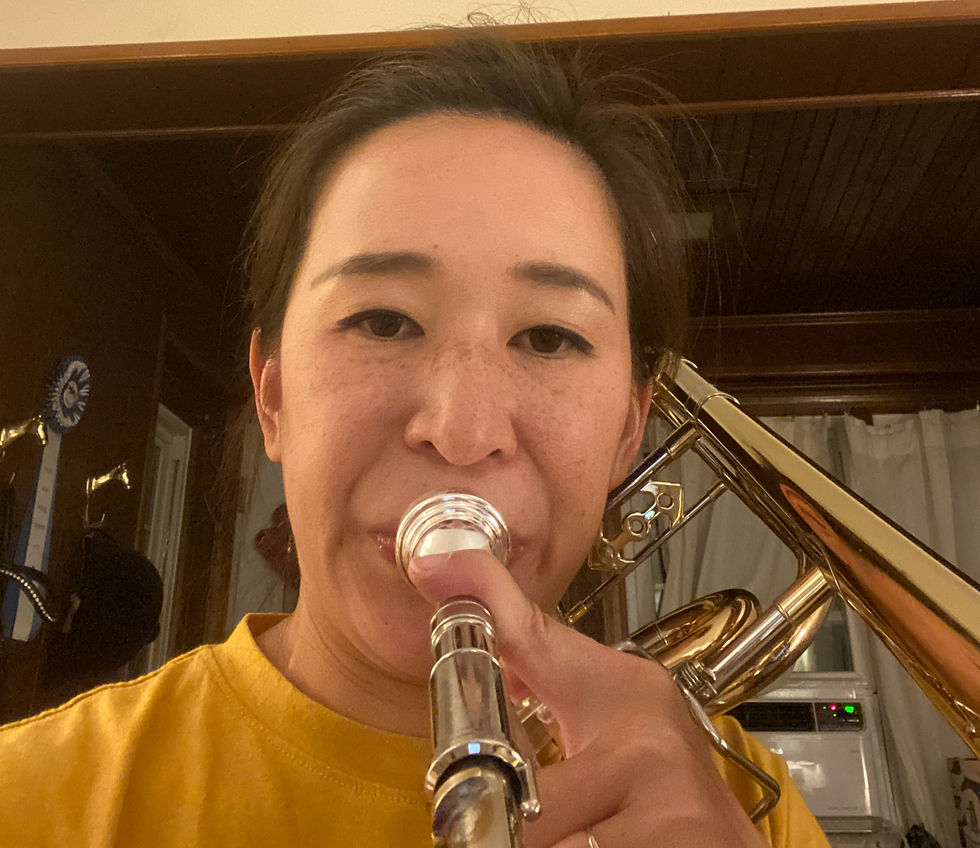
This is a picture I took of myself in 2023. You can see how the nasal elevators (the crease you see around my nose to the corner of my lips) are deeper on my right side. This is where I felt the spasms. The crease on the left side is now almost completely gone when I play. A bit still lingers on the right side, but it looks nothing like this photo now.
Uncontrollable bad sound with tremor
This is the symptom that forced me to finally acknowledge dystonia. Out of nowhere on a performance, my sound was thin, raspy, metallic, and was shaking on its own. Especially in the higher range, which has been my good range throughout my years of issues.


Comments